
St Anne's Catholic
Primary School



Our Curriculum
The curriculum at St Anne’s Catholic Primary School is ambitious, inclusive and firmly rooted in Gospel values, nurturing well-rounded individuals who are confident learners, curious about the world and religiously literate. It is carefully sequenced to build securely on prior knowledge, ensuring pupils develop strong core skills in reading, writing, mathematics and ICT alongside essential life skills such as oracy, digital literacy, problem solving and teamwork. We deliver a knowledge-rich curriculum balanced with skills and meaningful experiences, using high-quality, evidence-based programmes including Little Wandle, VIPERS, Herts for Learning Essential Writing, White Rose Maths and the Kapow Primary Curriculum. Our approach is “nationally defined and locally enacted,” with national curriculum entitlement thoughtfully adapted to reflect our local context and the needs of our community. These adaptations strengthen Catholic Social Teaching, British Values, cultural capital and pupils’ moral, social and spiritual development, preparing children well for life in modern Britain. Enrichment opportunities, including culture, sport, outdoor learning and civic engagement, are a valued and integral part of our curriculum offer. With inclusion at its heart, our curriculum ensures all pupils, including those with SEND or from disadvantaged backgrounds, achieve well and leave St Anne’s as confident, reflective and responsible young people ready for the next stage of their education.
Our phonics curriculum, delivered through the Little Wandle Phonics Scheme, ensures clear continuity and progression from EYFS through Year 2, with daily lessons that use consistent language, routines and resources. Engaging, well-structured lessons and regular reading practice sessions help children develop strong decoding, fluency, prosody and comprehension skills. Ongoing assessment informs targeted ‘keep-up’, small group and one-to-one support enabling all children make good progress from their individual starting points. We work closely with families to support reading at home, helping children to rehearse new sounds, tricky words and build confidence as independent readers.
Our reading curriculum for Years 3–6 is built around the study of high-quality texts linked to the HfL Essential Writing programme and ensures strong engagement and clear continuity through progressive teaching of the VIPERS Reading Domains. Carefully sequenced lessons develop vocabulary, comprehension, accuracy and prosody through repeated reading and the structured ‘I do, We do, You do’ approach, supported by appropriate scaffolds for all learners. Ongoing formative and summative assessment informs targeted support, particularly for SEN and focus pupils, enabling all children make good progress from their starting points. A strong culture of reading for pleasure is promoted through inviting reading environments in each classroom, regular DEAR time, reading challenges, volunteers, library access and celebration of achievement.
Our writing curriculum is based on the HfL Essential Writing programme which develops pupils’ understanding of a wide range of genres through the study of high-quality texts, explicit teaching of text and grammar features, and the application of learning in purposeful final outcomes for real audiences. Lessons are carefully planned with clear learning objectives, effective modelling using the ‘I do, We do, You do’ approach and a strong focus on pupil talk to rehearse and refine ideas. Accessible scaffolds, in-lesson support and targeted catch-up ensure all children, including those in EYFS through daily writing opportunities, make strong progress towards independence and confidence as writers. Regular assessment, feedback and celebration of achievement—through marking, displays, sharing work and certificates—validate effort, inform next steps and promote pride in high-quality writing and presentation.
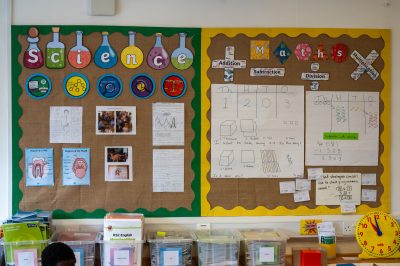
Our maths curriculum follows the White Rose scheme to ensure clear continuity and progression, with learning carefully built on secure prior knowledge and supported through targeted pre-teaching where needed. Lessons are delivered using the apprenticeship approach and the concrete–pictorial–abstract (CPA) progression, enabling pupils to develop deep understanding, confidence and independence. Regular Mathematical Fluency sessions and effective questioning strengthen accuracy, reasoning and application, supported by well-resourced classrooms and purposeful working walls. Ongoing formative and summative assessment, alongside targeted in-lesson support and interventions, ensures all pupils are challenged, supported and able to make strong progress.
Our foundation subjects curriculum is delivered through the KAPOW, Living Life to the full and Purple Mash ICT schemes to ensure clear continuity, progression and full coverage of the National Curriculum, and ensuring a carefully sequenced development of skills, knowledge and subject-specific vocabulary. In September 2025, we introduced a revised, themed curriculum map that strengthens links between subjects, enabling pupils to apply knowledge across disciplines and deepen their understanding. The curriculum has been further adapted through bespoke Unit Plans that embed Catholic Social Teaching, British Values, Social and Moral Education and the development of Cultural Capital, while applying key basic skills including reading, writing, maths and ICT. Learning is enriched through visits, visitors and creative teaching approaches, with effective modelling, inclusive scaffolds and regular feedback ensuring all pupils are engaged, supported and able to make strong progress.
Curriculum overviews (Letters)
Curriculum letters are sent home each half term to inform parents of what pupils are learning across the different subjects, as well as being accessible here.